Ashish Women Care & Fertility Clinic
IVF
In Vitro Fertilization (IVF) is one of the most commonly used and effective assisted reproductive technologies (ART) to help couples overcome infertility. In IVF, eggs are retrieved from the ovaries, fertilized by sperm in a laboratory, and then transferred as embryos into the uterus to achieve pregnancy.
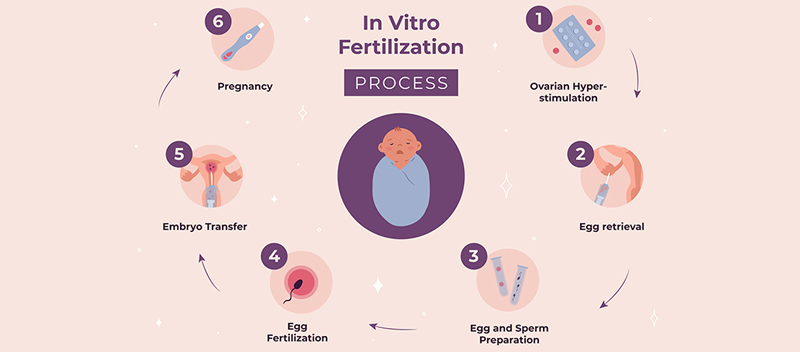
How IVF Works: Step-by-Step
The IVF process involves several stages, usually taking around 4-6 weeks for each cycle. Below is an overview of the steps:
Ovarian Stimulation
- Hormonal Injections: The woman receives daily injections of hormones (gonadotropins) to stimulate her ovaries to produce multiple eggs rather than the single egg released during a normal menstrual cycle.
- Monitoring: Ultrasound scans and blood tests are done to monitor the growth of ovarian follicles, which contain the eggs.
- Trigger Shot: Once the follicles are ready (usually 10-14 days of injections), an injection of human chorionic gonadotropin (hCG) or a similar medication is administered to trigger the final maturation of the eggs.
Egg Retrieval (Oocyte Retrieval)
- Procedure: About 34-36 hours after the trigger shot, a minor surgical procedure called transvaginal ultrasound aspiration is performed to retrieve the eggs. A thin needle is passed through the vaginal wall and into the ovaries to collect the eggs.
- Sedation: The procedure is usually done under light sedation or anesthesia and takes about 20-30 minutes.
- Egg Count: The retrieved eggs are then counted and evaluated for maturity.
Sperm Collection
- The male partner provides a sperm sample on the day of egg retrieval through ejaculation. If needed, sperm can also be surgically retrieved from the testicles in cases of male infertility (such as azoospermia).
- Sperm Preparation: The sperm sample is washed and processed in the lab to isolate the healthiest, most motile sperm for fertilization.
Fertilization
- Conventional IVF: The eggs and sperm are combined in a petri dish, allowing natural fertilization to occur. The sperm must penetrate the outer layer of the egg.
- Intracytoplasmic Sperm Injection (ICSI): For cases of male infertility or previous IVF failures, a single sperm is directly injected into the egg (ICSI).
- Monitoring: The eggs are checked the next day for signs of fertilization, and successful fertilization results in embryos.
Embryo Development
- After fertilization, the embryos are cultured in a controlled laboratory environment for 3-5 days. They can develop into blastocysts, which have a higher chance of implantation.
- Embryo Grading: The quality of the embryos is evaluated based on factors like cell division, appearance, and development stage.
- In some cases, embryos may be tested for genetic conditions through preimplantation genetic testing (PGT) before being transferred to the uterus.
Embryo Transfer
- Procedure: After 3-5 days of embryo development, one or more embryos are selected for transfer. A thin catheter is used to place the embryos into the uterus.
- The procedure is quick, does not require anesthesia, and is usually painless.
- The number of embryos transferred depends on the woman’s age, embryo quality, and other factors, though many clinics recommend transferring a single embryo to reduce the risk of multiple pregnancies.
Luteal Phase Support
- After the embryo transfer, the woman may be given progesterone supplements (either as injections, vaginal suppositories, or pills) to help prepare the uterine lining for implantation and support early pregnancy.
Pregnancy Test
- About 10-14 days after the embryo transfer, a blood test is done to check for pregnancy by measuring levels of human chorionic gonadotropin (hCG), a hormone produced during pregnancy.
- If the test is positive, follow-up ultrasounds will be scheduled to confirm pregnancy and assess the health of the embryo.
Who Should Consider IVF?
IVF is typically recommended for couples facing:
- Blocked or Damaged Fallopian Tubes: When natural conception is not possible due to tubal issues.
- Male Infertility: Such as low sperm count, poor motility, or sperm shape issues.
- Ovulation Disorders: Like polycystic ovary syndrome (PCOS) or other conditions where ovulation is irregular or absent.
- Endometriosis: A condition where tissue similar to the lining of the uterus grows outside it, which can affect fertility.
- Unexplained Infertility: When no clear cause of infertility is found after thorough testing.
- Genetic Disorders: Couples at risk of passing on genetic diseases can use IVF with preimplantation genetic testing (PGT) to select embryos free of the condition.
- Previous IVF Failures: Couples who have undergone IVF without success may attempt additional cycles.
Success Rates of IVF
- Age of the Woman: Women under 35 have higher success rates, while success rates decrease as age increases due to egg quality.
- Cause of Infertility: Success may vary depending on the specific fertility issues being treated.
- Embryo Quality: Higher-quality embryos have a better chance of leading to pregnancy.
- Previous Pregnancy History: A history of successful pregnancies (even if not through IVF) may increase the likelihood of success.
In general:
- Women under 35 may have a success rate of about 40-50% per cycle.
- Women between 35-40 may have a success rate of 30-40% per cycle.
- Women over 40 typically have success rates below 15-20% per cycle.
IVF Alternatives
If IVF is not suitable or unsuccessful, couples may consider other options, including:
- Intrauterine Insemination (IUI): A less invasive and less expensive option where sperm is directly inserted into the uterus.
- Egg or Sperm Donation: For cases where one partner cannot provide viable eggs or sperm.
- Surrogacy: Using another person to carry the pregnancy.